


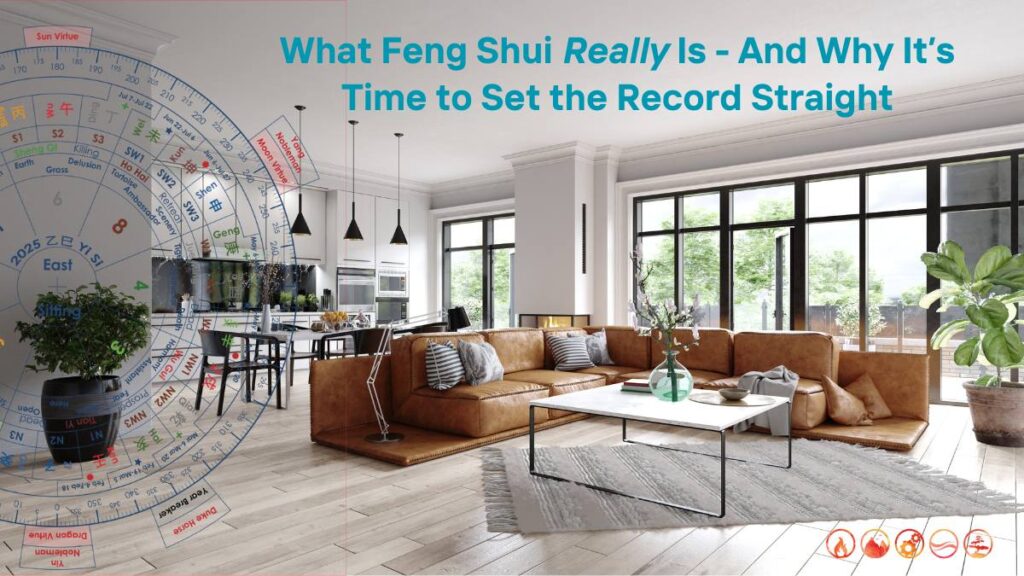
What Feng Shui Really Is – And Why It’s Time to Set the Record Straight
When people hear the words “Feng Shui,” what often comes to mind are bamboo flutes, lucky frogs, wind chimes, crystals, and perhaps a ba gua mirror or two. Over the years, the knowledge of Feng Shui has been misunderstood, commercialized and reduced to decorative fixes. Feng Shui’s reputation as a powerful and legitimate system has been diluted—overshadowed by trinkets and misconceptions with many people dismissing it as superstition or old folklore.
I’ve been practicing and teaching Feng Shui for over 30 years and my intention is to demystify what Feng Shui actually is, to separate fact from fiction, and to show you how this time-tested science can create measurable, tangible results when applied properly.
Let’s begin by addressing a core misunderstanding: Classical Feng Shui is not about objects—it’s about energy, timing, space, and alignment. When Feng Shui is done well, it can bring tangible shifts to your life = more clarity, flow, opportunities and harmony.
Not All Feng Shui is the Same
One of the most common questions I’m asked after a lecture or consult is:
“Did I buy the wrong cure?” or “Why didn’t you tell me to place something in the money corner?”
This points to the heart of the problem. What most people have encountered is New Age Feng Shui—a Westernized modern version or blend of symbolism, pop psychology, and decorative placement. While well-meaning, this isn’t rooted in the rigorous, deeply mathematical system of Classical Feng Shui in Chinese metaphysics
In Classical Feng Shui, we don’t work with objects. We work with Qi—the invisible energetic life force that flows through our environment. We analyze how Qi moves through time and space and how it interacts with you, your home, and your life. We use formulas and time-tested methods, not lucky charms.
So, What Is Classical Feng Shui?
Classical Feng Shui is a part of a larger body of Chinese Metaphysics, known as the Five Arts (Wu Shu). Specifically, Feng Shui falls under the branch of Physiognomy—the study of form and environmental influences. Originally known as Kan Yu, it began as a practice to locate burial sites (Yin Feng Shui) before evolving into a sophisticated system for living environments (Yang Feng Shui).
All Classical Feng Shui schools (San Yuan, San He, Xuan Kong, Eight Mansions) are based on ancient texts, and all consider four foundational components:
- The People (who is living or working there)
- The Building (the structure and layout)
- The Time (when it was built and current energy cycles)
- The Environment (surrounding landforms and external Qi)
There is no mention of frogs, crystals, or color cures in any of the classical texts. These are cultural overlays that have crept into public perception over time.
Why It Matters
We live in a world that is quickly changing, and more and more people are seeking clarity, direction, and stability. When you understand your environment as a living system—one that either supports or hinders your potential—Feng Shui becomes a powerful tool for conscious change.
When you use Classical Feng Shui properly, you’re aligning your space with nature’s rhythms and cycles in a way that directly supports your goals. Whether your goals are about improving health, enhancing relationships, or growing your business, the key question I ask is always the same: Is your space working with you or against you?
Feng Shui is a strategic tool for life planning. It allows us to assess what lies ahead—because Qi is cyclical, and energy patterns can be calculated. When combined with BaZi (your Destiny chart), we gain a powerful roadmap for how best to navigate upcoming opportunities and challenges.
A Science Rooted in Wisdom—Not Religion
It’s important to clarify: Classical Feng Shui is not religious. It has nothing to do with statues, beliefs, or spirituality in the Western sense. While some modern practices incorporate Taoist imagery, these are not required—and in fact, can often be a distraction. The true foundation of Feng Shui lies in numbers, directions, and patterns—tools like the BaGua, He Tu, Lo Shu, and the Five Elements, all grounded in logic, not belief.
The Journey Ahead
In the coming months, I’ll be sharing more insights, tools, and practical applications that you deepen your understanding of Classical Feng Shui to bring harmony, clarity, and alignment into your home and life. My intention is to help you understand how energy flows and how you can shape your environment in ways that support your purpose.
If you’ve only been exposed to what I call “New Age Feng Shui” until now, I invite you to keep an open mind. This journey will bring you back to the roots—back to a system that is empowering, and incredibly effective when applied with precision.
Let’s return Feng Shui to its rightful place—not as superstition, but as a time-tested art and science of living in alignment with the forces of Heaven, Earth, and Humanity. And if you are feeling called to explore Classical Feng Shui, check out my Feng Shui Mastery Immersion Program